

Behaviour
At St Michael’s C.E. Primary School, we are committed to creating a calm, safe, respectful and happy environment in which every child can flourish.
Our approach to behaviour is built on positive relationships, clear expectations and consistency. We explicitly teach children how we expect them to behave and support them to develop the skills they need to manage their behaviour, build positive relationships and make appropriate choices.
Our approach is underpinned by our Christian vision, ‘Courage to Flourish in the Love of God’, and particularly by our values of love, forgiveness and hope.
Our Behaviour Expectations
Throughout school, we use three simple expectations:
Be Ready
Be Respectful
Be Responsible
These expectations apply throughout the school day and are explicitly taught, modelled and reinforced by all adults.
We believe that consistency is essential. Adults use clear and consistent language, routines, praise and follow-up so that children understand what is expected of them and feel safe and supported.
Where children find behaviour expectations difficult, staff respond calmly and fairly. Children are supported to reflect on their choices, understand how their behaviour may have affected others and, where appropriate, put things right through restorative conversations.
We recognise that some pupils may require additional support or reasonable adjustments to successfully meet our expectations. We work closely with children, parents and carers, our SENDCo/Inclusion Lead and other professionals to ensure that individual needs are understood and appropriately supported.
Working in Partnership with Families
Positive behaviour is most successful when school and families work together. We encourage parents and carers to support our expectations at home and to contact us if they have any concerns about their child’s behaviour or wellbeing.
What Our Pupils Tell Us
We regularly gather pupil voice to help us understand how children experience behaviour, safety and support across the school.
In February 2026, we carried out a whole‑school behaviour questionnaire with pupils to understand their experiences and gather their views on our behaviour culture. The responses showed that children feel safe, well‑supported and positive about behaviour across the school.
Pupils reported that lessons are calm, routines are well‑embedded, and adults consistently use restorative approaches to help them make things right. The feedback also highlights that children enjoy coming to school, feel encouraged to make positive choices, and value the support offered by staff.
These insights will continue to shape our behaviour work and help us build on what is already working well.
| Question | % Yes |
| Do you feel safe at school? | 99% |
| Is behaviour good around school? | 96% |
| Is behaviour good in lessons? | 96% |
| Is behaviour getting better? | 96% |
| Do you enjoy your lessons? | 97% |
| Do adults help when there is poor behaviour? | 100% |
Behaviour Hub
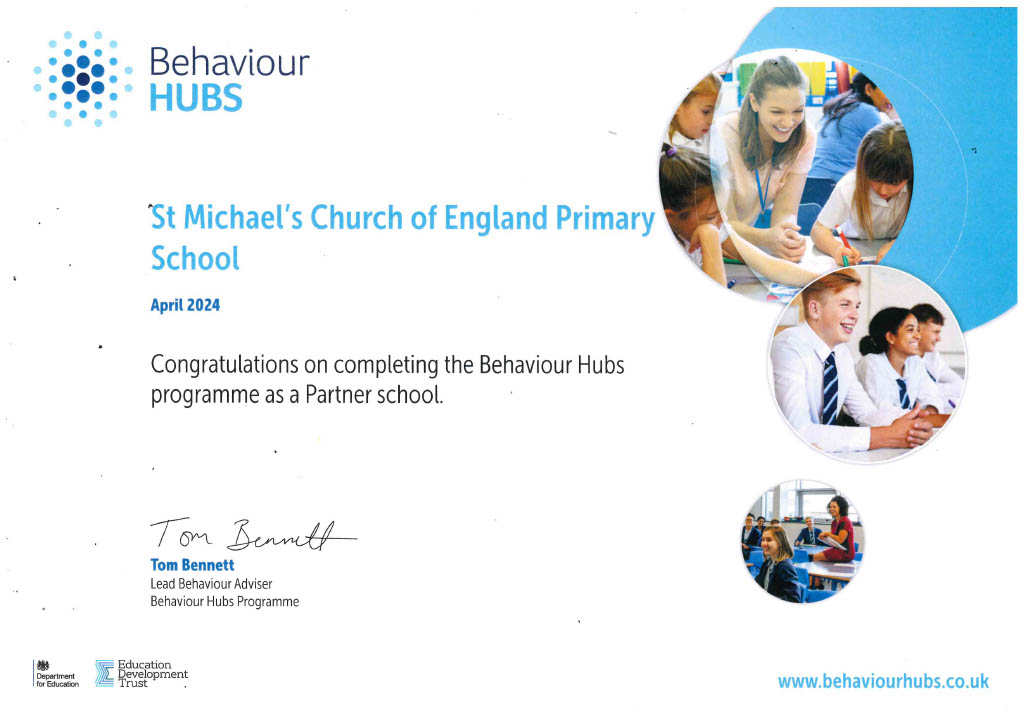
We are a partner school with the Department for Education’s Behaviour Hub which supports schools with creating a calm, safe and supportive school environment. Through the Behaviour Hub, we are able to work alongside other schools to improve behaviour culture and ensure success for all.
Our Behaviour Policy
Our Positive Relationships and Behaviour Policy provides further information about our approach, including recognition and rewards, behaviour support, restorative conversations, additional support and consequences.
We want our approach to behaviour to be clear and accessible for all families. A parent-friendly version of our Positive Relationships and Behaviour Policy is available below and gives a concise overview of our expectations, routines, rewards and how we support children to make positive choices.
The full policy can be accessed via the links below. This explains the school’s approach in greater detail, including roles and responsibilities, behaviour support, restorative conversations, reasonable adjustments, SEND, serious incidents and suspensions/exclusions.