

Mathematics
Our Vision for Mathematics
At St Michael’s C of E Primary School, we want every child to develop the understanding, confidence and curiosity to flourish as a mathematician. Guided by our vision, “Courage to flourish in the love of God”, we encourage children to persevere, learn from mistakes and explain their thinking. Our curriculum develops fluency, mathematical reasoning and problem solving so children can use mathematics confidently in lessons and everyday life.
A Carefully Sequenced Curriculum
Our curriculum builds mathematical knowledge in small, connected steps. White Rose small steps support planning, alongside our school’s yearly overview, calculation policy, vocabulary progression and priority areas of learning. Children meet a broad range of mathematics, including number, calculation, fractions, measurement, geometry and statistics, with further concepts introduced as they progress. New learning draws on what children already know.
Understanding Before Procedures
We explicitly connect practical objects, pictures and mathematical symbols. This is called the concrete, pictorial and abstract (CPA) approach. Children might build a calculation with counters, represent it using a bar model and then record it with numbers. Resources remain available across the school whenever they help children understand or explain an idea. Our calculation policy ensures that methods and representations build consistently from Reception to Year 6.
I Do, We Do, You Do
Teachers model a method and explain their thinking: “I Do”. Children then work through examples with the teacher: “We Do”, allowing misunderstandings to be spotted and addressed. When understanding has been checked, children practise independently: “You Do”. Pupils who need more teaching receive prompt support. Children also compare methods, explain why answers are correct and apply their learning to problems.
Learning to Talk Mathematically
Mathematical vocabulary is explicitly taught and revisited. Our Year 1 to Year 6 vocabulary progression helps children build increasingly precise language. Models, sentence stems and discussion support children to explain, compare and justify their ideas.
What is MOT?
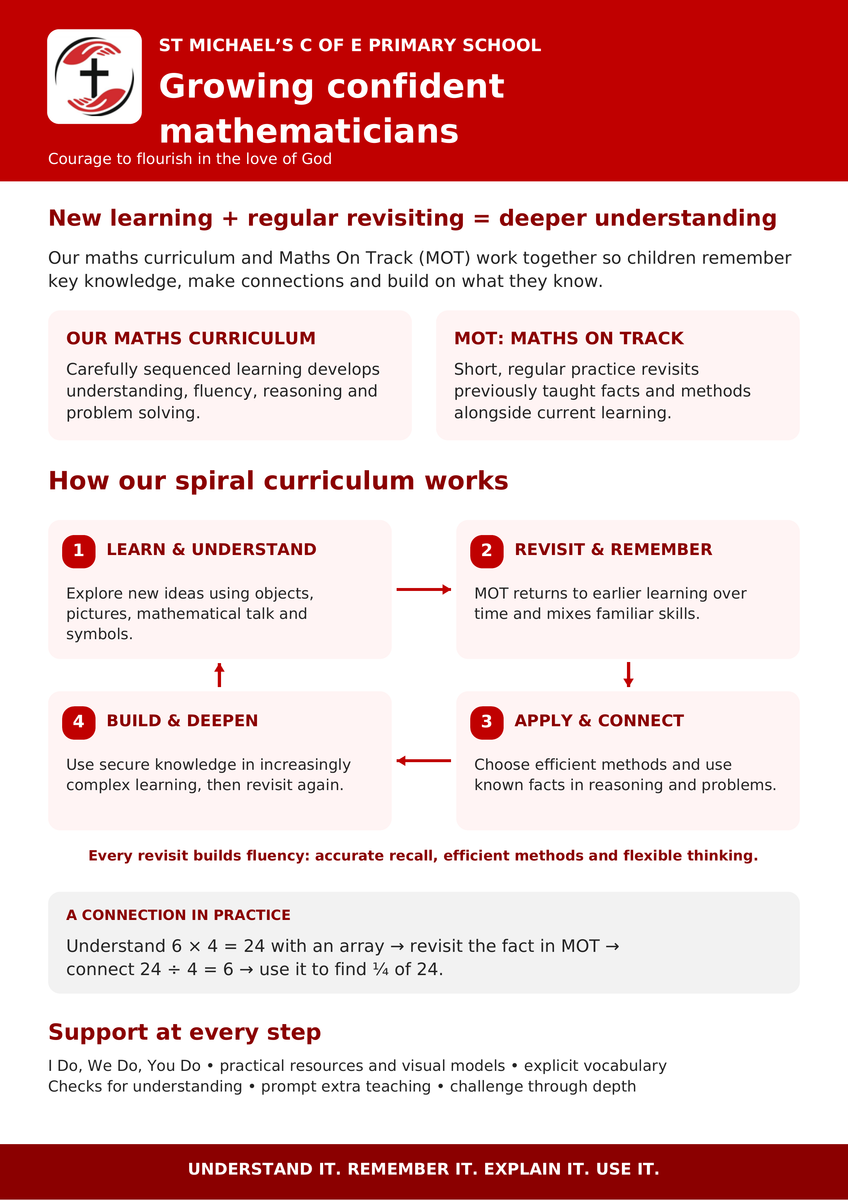
MOT stands for Maths On Track. It provides short, regular opportunities to retrieve and practise previously taught mathematics alongside the main maths curriculum. Teachers plan the content using curriculum priorities and assessment information, so important facts and methods are revisited over time. MOT helps children keep earlier learning secure while they develop new understanding.
How does this create a spiral curriculum?
Our main maths lessons introduce and deepen concepts in a carefully planned sequence. MOT brings children back to earlier learning at spaced intervals and mixes previously taught skills. Together, these approaches create a spiral curriculum: children revisit important ideas, make new connections and apply them with increasing independence and complexity. Revisiting is purposeful, with teaching adjusted when gaps or misconceptions appear.
Learn and understand. Build meaning using practical resources, pictures, talk and symbols.
Revisit and remember. Retrieve earlier facts and methods through MOT and other fluency routines.
Apply and connect. Use secure knowledge to choose methods, reason and solve problems.
Build and deepen. Extend understanding in new learning, then return to it again over time.
An example of the spiral:
A child first understands 6 × 4 = 24 by making an array. MOT later revisits the fact. The child connects it to 24 ÷ 4 = 6 and uses this knowledge to find one quarter of 24. The same secure fact supports increasingly connected mathematics. This is an illustration of the approach, rather than a fixed lesson sequence.
Fluency means more than speed
We develop accurate recall, efficient calculation and flexibility in choosing a suitable method. Children need to understand why a method works and when to use it. Regular arithmetic practice, number-fact teaching and retrieval support this alongside reasoning and problem solving.
How practice develops across school
Early Years and Key Stage 1 build counting, subitising (recognising a small quantity without counting), number bonds and comparison through short routines. Year 2 combines Mastering Number, MOT and regular arithmetic practice. Years 3 and 4 use daily Number Sense alongside multiplication teaching and arithmetic. Practice continues in Years 5 and 6; Year 6 has MOT five times a week and arithmetic practice twice a week.
Strong foundations in Early Years
Early mathematics develops through practical exploration, purposeful play, adult interaction and short teaching routines. Children develop their understanding of number, counting, quantities, patterns and mathematical language. Our strong foundations progression supports continuity into Year 1 and helps teachers identify knowledge that needs further development.
Responsive teaching and additional support
Teachers use questions, observations, children’s work and assessment to identify what each child understands. Misconceptions are addressed during teaching. Children who need further explanation may join a short “scoop” group for additional teaching. Support may include pre-teaching vocabulary, breaking learning into smaller steps, revisiting a model or practising a specific fact or method.
For pupils with special educational needs and disabilities (SEND), support starts from the earliest insecure understanding. Adults use the same agreed representations as the main lesson to maintain clear connections. Visual models and sentence stems also help pupils who are learning English as an additional language. Children who are secure deepen their learning through explanation, comparison and more demanding applications.
Times tables and the Multiplication Tables Check
Multiplication understanding and recall are built progressively from Year 2 and continue beyond Year 4. Children explore equal groups, arrays, doubling and links between tables. Times Tables Rock Stars (TTRS) supports practice in school and at home. Teachers use its information to identify particular facts needing practice. Parent workshops explain the Year 4 Multiplication Tables Check (MTC) and how families can support learning.
How we check progress
Teachers combine day-to-day assessment with planned checks of priority knowledge, arithmetic and multiplication facts. The same priority content is revisited at assessment points to check whether knowledge is becoming secure. Results inform teaching and additional support. Leaders review headline information each half term alongside children’s books, lesson visits and pupil discussion to evaluate provision and identify next steps.