

EYFS Curriculum
At St Michael’s C.E. Primary School, our Early Years curriculum gives every child the strong foundations they need to flourish. Rooted in our Christian vision, “Courage to Flourish in the Love of God,” we want children to feel safe, valued, confident and ready to learn.
Our curriculum reflects the varied starting points of our children and prioritises language, secure relationships, independence, self-care, confidence and first-hand experiences. We are ambitious for all children and aim for them to leave Early Years as curious, independent and resilient learners, ready for Year 1 and beyond.
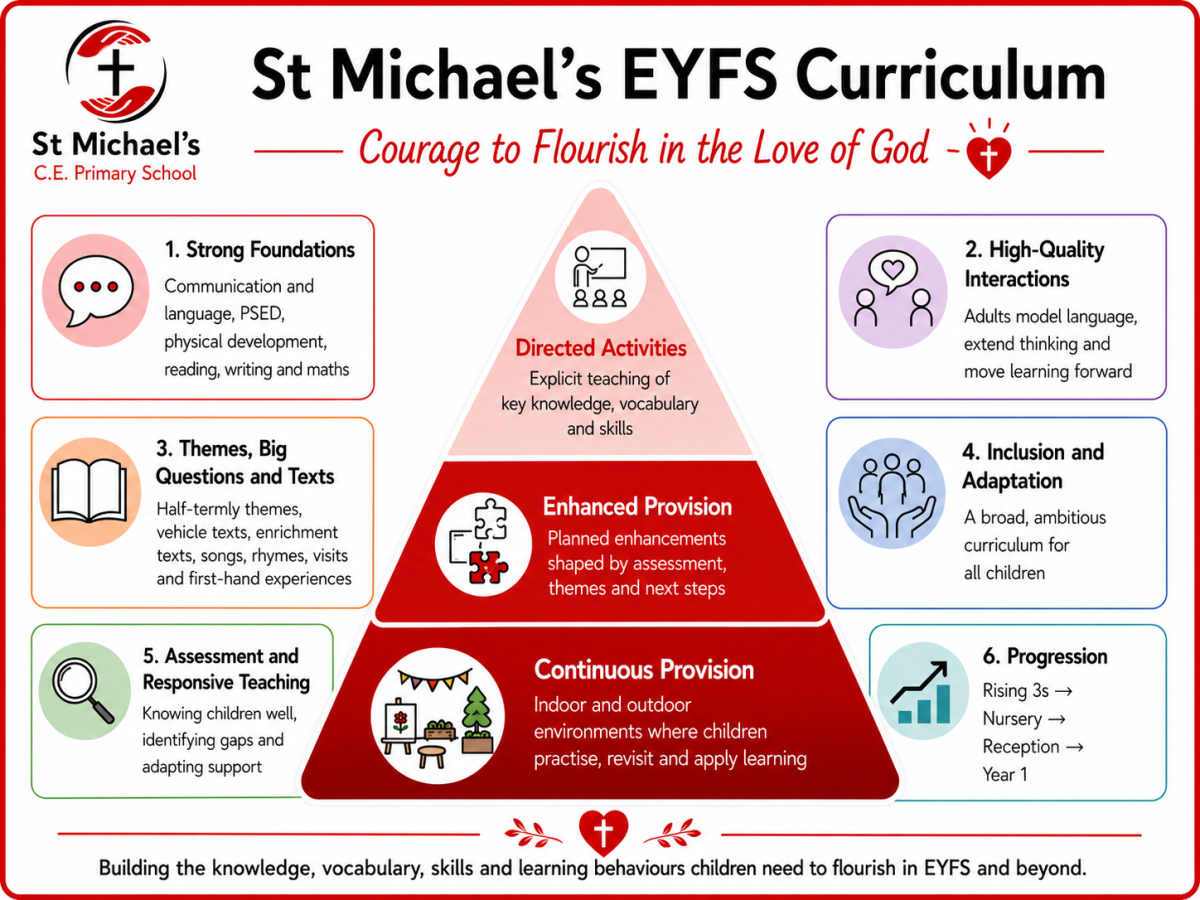
Our Early Years pedagogy is based on the Early Excellence Curriculum Development Model. Learning is carefully planned through play, purposeful provision and high-quality adult interaction.
We use a three-layer curriculum model: continuous provision, enhanced provision and directed activities. This ensures children are taught important knowledge and skills, have time to practise and revisit learning, and can apply what they know in meaningful contexts.
Adults play a key role in moving learning forward through modelling, questioning, scaffolding, vocabulary development and responsive interaction, helping every child make progress from their individual starting point.
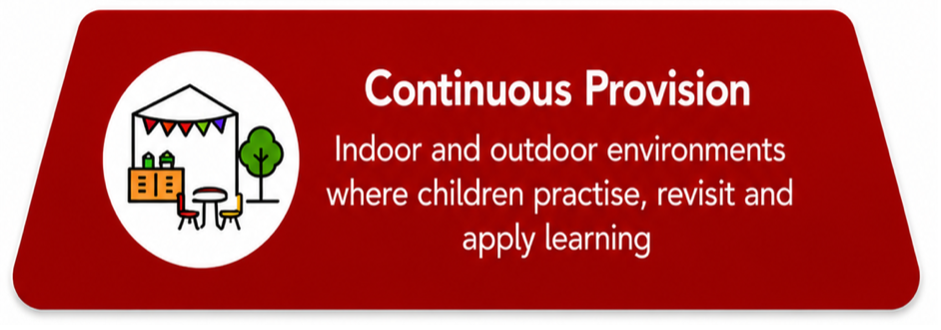
Continuous provision is at the heart of our EYFS curriculum. It includes the carefully planned areas, resources and routines available every day, both indoors and outdoors, to support play, exploration, independence, communication and repeated practice.
Children are taught how to use the provision safely and purposefully. Through play, they revisit and apply taught knowledge and skills, helping them to remember more, do more and grow in confidence.
Adults support learning through high-quality interactions, modelling language, extending thinking, scaffolding learning and helping children take their next steps.
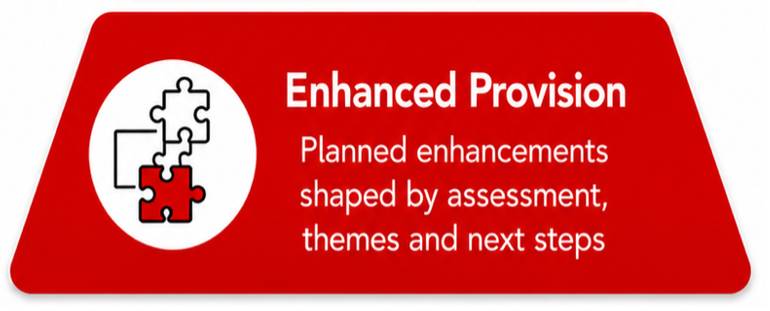
Enhanced provision builds on continuous provision by adding carefully chosen resources, experiences, prompts, books, artefacts or challenges for a set period of time.
Enhancements are planned in response to children’s interests, observations, assessment information, curriculum themes, identified gaps, key vocabulary, stories, seasonal changes, visits and first-hand experiences.
They are used purposefully to help children practise, revisit and apply key knowledge and skills. Adults introduce enhancements, model how to use them, observe children’s responses and use high-quality interactions to move learning forward.
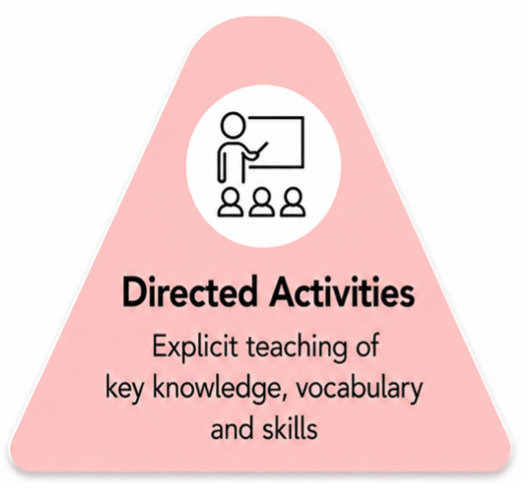
Directed activities are planned adult-led learning opportunities, delivered through whole-class teaching, small groups or individual support.
They are used to teach specific knowledge, skills and vocabulary. In Nursery, this includes communication and language, PSED, physical development, early literacy, early mathematics and wider curriculum experiences. In Reception, this builds towards more explicit teaching of phonics, reading, writing, mathematics and wider curriculum knowledge.
Adults check understanding, model learning, address misconceptions, provide feedback and adapt teaching so that all children can make progress from their starting points.